
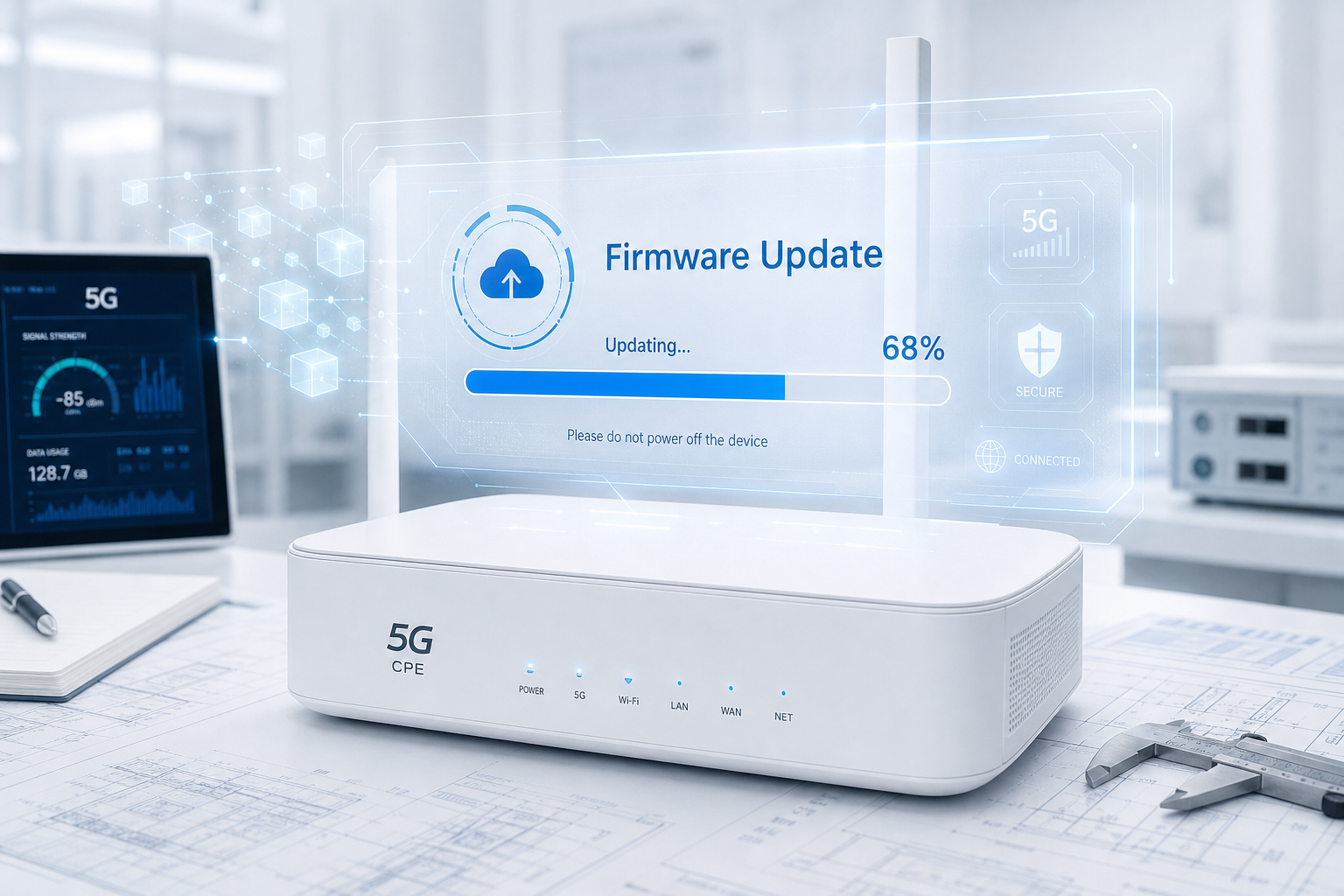
As enterprise 5G CPE deployments scale from hundreds to tens of thousands of distributed gateways, the ability to securely and reliably update device firmware over the air becomes a critical operational capability. This technical deep-dive examines the firmware over-the-air (FOTA) update architectures being adopted by leading CPE manufacturers and network operators in 2026, covering delta update mechanisms, A/B slot fallback strategies, cryptographic security frameworks, and fleet-scale update orchestration best practices that B2B buyers should evaluate when selecting 5G CPE platforms.
Why FOTA Architecture Matters for Enterprise CPE Deployments
In traditional enterprise networking, firmware updates were infrequent events — often deferred until the next scheduled maintenance window, which could be months away. The 5G CPE landscape has fundamentally changed this operational model. With 3GPP specifications evolving through biannual Release cycles, operator network feature rollouts introducing new RAN capabilities, and the expanding attack surface of always-connected cellular gateways requiring regular security patches, B2B CPE deployments now require firmware update cadences measured in weeks rather than quarters.
The stakes are high. A poorly executed firmware update that bricks devices, introduces regressions, or creates security vulnerabilities can disrupt connectivity for hundreds or thousands of enterprise sites simultaneously. Industry analysis indicates that CPE firmware-related outages account for approximately 31% of enterprise FWA service disruptions, making FOTA reliability a direct determinant of service availability and customer satisfaction.
Delta Update Mechanisms: Minimizing Bandwidth and Downtime
Full-image firmware updates, where the entire firmware binary (typically 128-512 MB for modern 5G CPE devices) is downloaded and flashed, impose significant operational costs at fleet scale. A fleet of 10,000 CPE devices receiving a 256 MB full-image update consumes approximately 2.5 TB of cumulative cellular data — representing substantial bandwidth costs and, in regions with data caps, potential service throttling.
Delta OTA (differential update) technology addresses this challenge by transmitting only the binary differences between the currently installed firmware version and the target version. Modern delta update engines, based on algorithms such as bsdiff, Courgette, or vendor-proprietary implementations, achieve compression ratios of 70-95% compared to full-image updates. A 256 MB firmware image may be delivered as a delta package of just 15-75 MB, dramatically reducing cellular data consumption and update download time.
Key technical considerations for delta update implementations include:
Block-Level Differencing: The delta engine operates at the block or sector level, comparing cryptographic hashes of firmware partitions between source and target versions. Only modified blocks are included in the delta package, with the on-device update agent reconstructing the target image by applying patches to existing blocks in place, minimizing temporary storage requirements on resource-constrained CPE hardware.
Multi-Version Delta Chains: In heterogeneous fleets where devices may be running multiple different firmware versions (due to staged rollouts, regional variants, or missed previous updates), the FOTA server must either generate and store delta packages for every possible source-to-target version pair, or implement a delta chain mechanism where the device sequentially applies multiple deltas to reach the target version. Leading FOTA platforms now support adaptive delta generation, where the server computes the optimal delta path based on the device’s current version at update time, balancing package size against update complexity.
Compressed Delta Delivery: Delta packages are typically further compressed using LZMA2 or Zstandard algorithms before transmission, achieving an additional 20-40% size reduction beyond the differential compression. The update agent decompresses the package in a streaming fashion during application, avoiding the need to store both the compressed package and uncompressed delta simultaneously in device memory.
A/B Slot Fallback Architecture: Ensuring Update Safety at Scale
The A/B (dual-bank) firmware architecture, originally pioneered by Google for Android OS updates and now widely adopted in embedded cellular devices, provides a robust mechanism for safe firmware updates with automatic rollback capability. In an A/B CPE, the device maintains two complete firmware partitions (Slot A and Slot B), with only one slot active at any given time.
The A/B update process follows a deterministic seven-step sequence:
- Status Check: The FOTA server queries the device for current active slot, firmware version, and slot health status.
- Delta Download: The delta update package targeting the inactive slot is downloaded to the device via HTTPS, with integrity verified through checksum validation.
- Inactive Slot Patching: The update agent applies the delta to the inactive slot’s firmware partition while the device continues normal operation on the active slot — a critical advantage that eliminates service downtime during the update application phase.
- Post-Apply Verification: The patched inactive slot undergoes cryptographic integrity verification (SHA-256 hash comparison against the expected target image) and, optionally, a simulated boot test.
- Slot Switch and Reboot: The bootloader is instructed to switch the active slot designation and the device reboots into the newly updated firmware. Typical reboot time is 45-90 seconds for embedded CPE devices.
- Post-Boot Health Check: Upon booting into the updated slot, the device executes a predefined health verification sequence: confirming WAN connectivity establishment, validating that core services (routing, DHCP, DNS proxy) are operational, and reporting health status to the FOTA management platform.
- Commit or Rollback: If all health checks pass within a configurable timeout window (typically 5-15 minutes), the update is committed and the previous slot is marked as the new inactive slot. If any health check fails, the bootloader automatically reverts to the previous firmware slot on the next reboot.
The A/B architecture provides several critical safety guarantees for enterprise CPE deployments. The most important is guaranteed recoverability: even if the new firmware image is completely non-functional (kernel panic, persistent boot loop, or radio initialization failure), the device can always fall back to the known-good previous firmware version. This eliminates the risk of “bricked” devices requiring physical access for recovery — an essential characteristic for CPE gateways deployed at unmanned remote sites, rooftop installations, or geographically distributed enterprise branch locations.
FOTA Security Architecture: Cryptographic Protections for the Update Pipeline
The firmware update pipeline represents one of the most security-critical attack surfaces in any connected device. A compromised update mechanism can be exploited to install persistent malware, establish backdoor access, or recruit devices into botnets. The following security controls should be mandatory requirements in any B2B CPE procurement:
Secure Boot and Hardware Root of Trust
The CPE must implement a hardware root of trust (HRoT) — typically a dedicated secure element or TPM 2.0-compliant chip — that anchors the entire boot and update chain. The HRoT stores an immutable public key (or hash of a public key) that the first-stage bootloader (boot ROM) uses to verify the signature of the second-stage bootloader. This verification chain extends through the OS kernel to the application firmware, ensuring that only cryptographically authenticated code executes on the device. Any firmware image that fails signature verification at any stage in the chain is rejected, preventing unauthorized or tampered firmware from being installed.
Firmware Image Signing
All firmware images (both full images and delta packages) must be digitally signed by the manufacturer or authorized operator using asymmetric cryptography (RSA-3072 or ECDSA P-384 minimum). The device verifies signatures before applying any update, using a public key that is itself protected by the secure boot chain. This prevents attackers from delivering malicious firmware even if they compromise the FOTA distribution server or man-in-the-middle the update download.
TLS 1.3 with Mutual Authentication
All FOTA communications between CPE devices and update servers must use TLS 1.3 with mutual (mTLS) authentication. The CPE presents a device certificate (provisioned at manufacturing and stored in the secure element) to authenticate itself to the FOTA server, while the server presents its certificate for device-side verification. This bidirectional authentication prevents both rogue devices from accessing the update infrastructure and rogue servers from delivering updates to legitimate devices.
Rollback Protection
To prevent attackers from exploiting known vulnerabilities by downgrading devices to older, vulnerable firmware versions, the CPE must implement anti-rollback protection. The secure element maintains a minimum acceptable firmware version counter that is incremented with each update and cannot be decremented. Any firmware image with a version number below this counter is rejected, even if it carries a valid cryptographic signature.
Fleet-Scale Update Orchestration Strategies
Managing FOTA operations across a fleet of thousands of geographically distributed CPE devices introduces significant orchestration complexity. Best practices for fleet-scale update management include:
Canary Deployments: Rather than pushing updates to the entire fleet simultaneously, operators should deploy to a small “canary” cohort (typically 1-5% of devices, selected to represent diverse hardware revisions, firmware baseline versions, and network conditions). The canary cohort is monitored for 24-72 hours post-update to detect regressions before broader rollout. Only after canary health metrics meet predefined thresholds is the update expanded to the full fleet.
Geographic and Topological Grouping: Updates should be deployable to device groups defined by geographic region, customer tenant, hardware revision, or network topology. This enables operators to sequence updates in a manner that minimizes correlated failure risk — for example, updating devices at different customer sites in staggered phases rather than simultaneously.
Time-Windowed Scheduling: Enterprise CPE updates should be schedulable within customer-defined maintenance windows to avoid disrupting business-critical operations. The FOTA platform must support timezone-aware scheduling with configurable blackout periods (e.g., “do not update between 08:00-18:00 local time on weekdays”) and the ability for enterprise administrators to approve or defer update windows through a self-service portal.
Bandwidth-Aware Throttling: At fleet scale, simultaneous update downloads from thousands of devices can overwhelm FOTA server infrastructure and enterprise WAN links. Intelligent update orchestration platforms implement token-bucket or leaky-bucket rate limiting, randomized download start times within update windows, and peer-to-peer update distribution (where CPE devices at the same site share downloaded packages via local LAN) to manage bandwidth consumption.
Honlly Telecom’s FOTA Capabilities
Honlly Telecom’s 5G CPE platforms incorporate industry-leading FOTA capabilities designed for enterprise-scale deployments. Our devices feature A/B slot firmware architecture with hardware root of trust anchored in TPM 2.0-compliant secure elements, delta update support achieving typical 80-90% compression ratios, and comprehensive remote management APIs that integrate with leading operator device management platforms including TR-369 USP (User Services Platform) and LwM2M.
For B2B buyers and operator partners managing large CPE fleets, Honlly provides a cloud-based FOTA orchestration platform supporting canary deployment workflows, geographic grouping, time-windowed scheduling, and real-time fleet health dashboards. Our engineering team works closely with enterprise customers to design FOTA strategies that align with their operational requirements and risk tolerance profiles.
Conclusion
Firmware over-the-air update capability is not merely a convenience feature for enterprise 5G CPE deployments — it is a fundamental operational necessity that directly impacts service reliability, security posture, and total cost of ownership. B2B buyers evaluating CPE platforms should rigorously assess FOTA architecture across the dimensions discussed in this guide: delta update efficiency, A/B slot recoverability, cryptographic security of the update pipeline, and fleet-scale orchestration capabilities. A CPE device with excellent RF performance but inadequate FOTA infrastructure will inevitably generate operational burden and security risk that undermines its initial performance advantages. In the enterprise 5G era, the quality of a CPE platform’s update architecture is as important as the quality of its radio.